Report of 1932 Society Lecture uncovered in New Zealand
- timhoyle7
- Oct 20, 2025
- 6 min read
We are immensely grateful to Shelley Jones of Auckland, New Zealand, who uncovered this fascinating piece while going through family papers and kindly took the time to contact us.
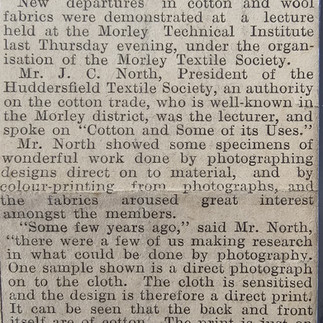
The find is an article from The Morley Observer dated 22 January 1932, reporting on a lecture given by Mr J. C. North, then President of the Huddersfield Textile Society, titled “Novel Cotton and Wool Fabric Designs.”
The article is remarkable for several reasons. Today, we rarely associate Huddersfield with the cotton industry—yet as this piece reminds us, it once played a significant role. (See our related post: [Meltham Mills: Huddersfield’s Forgotten Cotton Story].) Even more intriguingly, it describes experimental methods for printing photographic images directly onto fabric—more than fifty years before the advent of digital textile printing.
It’s a short and engaging read, offering a glimpse into Huddersfield’s inventive textile past. We highly recommend taking a few minutes to enjoy it.
Read the original article below.
Have you uncovered any historical textile stories or family connections to Huddersfield’s textile past? We’d love to hear from you — get in touch by emailing President@huddersfieldtextilesociety.org.uk
Lecture by Mr. J. C. North, President of the Huddersfield Textile Society
(Reported from the Morley Technical Institute event and published on January 22nd, 1932 in The Morley Observer )
Grateful thanks to Shelley Jones of Auckland, New Zealand who discovered this in family papers and took the trouble to contact the Huddersfield Textile Society about it in October 2025.
Novel Cotton and Wool Fabric Designs
COTTON EXPERT’S LECTURE AT MORLEY
HOW MACHINERY DEVELOPED FROM THE ANCIENTS.
New departures in cotton and wool fabrics were demonstrated at a lecture held at the Morley Technical Institute last Thursday evening, under the organisation of the Morley Textile Society.
Mr. J. C. North, President of the Huddersfield Textile Society, an authority on the cotton trade who is well known in the Morley district, was the lecturer, and spoke on “Cotton and Some of its Uses.”
Mr. North showed some specimens of wonderful work done by photographing designs direct on to material, and by colour-printing from photographs, and the fabrics aroused great interest amongst the members.
“Some few years ago,” said Mr. North, “there were a few of us making research in what could be done by photography. One sample shown is a direct photograph on to the cloth. The cloth is sensitised and the design is therefore a direct print. It can be seen that the back and front itself are of cotton. The print is just on one side, direct from the negative.
“There is also a sample here of cotton net of which thousands are made in the lace trade. The design on this d’oyley is printed with a solution of cotton and it will last as long as the rest of the material. It has been treated very severely in the washing, etc., and it is just as good as the rest of the cotton. This process is applied also by a firm in the Bingley district, but for wool, and some magnificent materials are turned out, and very delicate materials, printed in all colours, and in gold and silver.
“Another sample shows colour printing on material. There is one showing a more brilliant type of colour, and that is printed from a photographic base, really direct by rollers, but the whole thing is photographic. The photograph is transferred to one side of a sheet of aluminium and that is bent round the rollers. That sheet is etched from the photograph on it, and perfectly registered so that prints can be turned off in the whole roll.”
“Cotton yarns are largely used in this district, very much more than many of us appreciate. There are very many hundreds of thousands of pounds weight used in this district alone during a year. There are all sorts of processes connected with the manufacture of cloths, warps, wefts, twisting with other materials, etc., also for fancy yarns, and the raw cotton is also largely used for mixing and spinning with wool in other materials.”
Mr. North gave a short and interesting history of the development of cotton machinery, of which he has had a vast experience.
“Spinning of the fibre into thread,” he told his hearers, “was done by the ancients by means of a distaff and spindle, and even to-day one often sees this being done in the East. I have often watched the peasants in India and Burmah, and in the Outer Hebrides I have seen them spinning wool in the same way only a year or two ago.
“The first form of machine for spinning is that of a large wheel and spindle; for cotton it is fitted with a thin metal spindle. The method of operation is: some cotton fibres are drawn from a bunch and attached to the spindle, the wheel being turned by the left hand. A further quantity of cotton is supplied by the right hand, the fingers of which are occasionally dipped in chalk, for dryness. When a piece of yarn has been spun of the required thickness, which is accomplished by the spinner holding it between the finger and thumb and withdrawing the hand to the extent required, twist meantime being put in by the revolution of the spindle, the yarn so produced is wound on the spindle by turning it the reverse way to which it runs when spinning. Yarns of extreme fineness are spun in this rude fashion in India, and have been for generations.”
Early Inventions
“As the demand for cotton goods grew, the need arose for some mechanical method of drawing out a carded fleece at a regular rate. Hence was originated the system of drawing by means of rollers, with which the name of Arkwright is usually associated, but which was undoubtedly originated by John Wyatt, of Birmingham, about 1738. Immediately after this was the invention by Lewis Paul, a partner of Wyatt of Birmingham, in 1748, of a method of carding cotton by a revolving cylinder.
“In 1738, John Kay, of Bury, introduced the fly shuttle which enormously increased the power of the weaver, and there was hardly enough yarn to be got from the existing hand wheels. In 1769 Arkwright’s spinning machine appeared, and, in addition to the drawing rollers, it consisted of spindles driven by bands and having flyers upon the end by which the yarn was twisted. The spindles had bobbins mounted upon them; in short, this machine was the progenitor of the throstle and flyer spindle frame which was so long used. These spinning frames were gradually improved by Arkwright and James Hargreaves, of Blackburn, in 1764 to 1767.
“The next step was taken by Samuel Crompton about 1779, who produced a machine which, from its hybrid nature, was called a ‘mule.’ This was a crude machine but it contained within it many of the elements of the modern mule and had the delivery rollers and the sustainment of the spindles in a carriage, to which an alternate motion in a horizontal direction was given. His model rests at Hall-ith-Wood, Bolton, Crompton’s home.
“The early machines were called water-frames (from which comes the phrase ‘water twist’), because they were driven by water wheels.
“The increase in the dimensions speedily led to the adoption of improved methods of drawing out the carriage and to the adoption of bands by which it was drawn out equally throughout its length. The counter-faller wire appears to have been invented about 1790, also the use of an inclined plate for the guidance of the faller and the shaping of the cop.
“A very important improvement was made by Kennedy, of Manchester, who invented a method of actuating the rollers and spindles by three pulleys, two fast and one loose. Up to this time all the operations of actuating the faller and the reversal of the motion of the spindles were done by the spinner.
“Then came William Easton, 1818, and Richard Roberts, who made great improvements in the driving of all operations mechanically, and many of the motions for effecting the various movements.
“The ring spinning frame has been now largely adopted, as it more closely resembles the old throstle frames, and by its use a more even yarn can be spun than by the mules. The roving is delivered continuously through the rollers, and from there passes through a guide to a wire traveller which rotates around the ring and gives the necessary drag to the yarn to effect the twist in the yarn. The spindle speed varies from 9 to 10,000 revolutions per minute.”
“Although cotton spinning is generally talked of as being confined to Lancashire, it is a great mistake, and especially about Huddersfield; in fact the founders of the firm of which I am a member were in business about 1850 here. It may be news to many of you that when Huddersfield was incorporated as a Borough, and a coat of arms was designed, surmounting the design, in the mouth of the ram, a cotton boll was put, denoting the big industry of the town.” (Applause).
Mr. North was heartily thanked for his interesting discourse by Mr. G. Shenton, seconded by Mr. T. H. Dixon, and Councillor David Dickinson, for presiding at the lecture, was also accorded thanks




Comments