The Luddites in Huddersfield
Part 1 - Prelude to Luddism
A World in Transition
Introduction
Before the mills came to dominate the valleys of West Yorkshire, before the weaving sheds, the engine houses and the chimney stacks, there existed another textile world entirely. It was a world of farms, cottages and hillside communities — a world in which cloth production formed part of domestic life rather than standing apart from it. It is this society that D. F. E. Sykes describes so vividly in Ben o’ Bill’s, The Luddite, and it is this world that many Yorkshire Luddites came from.
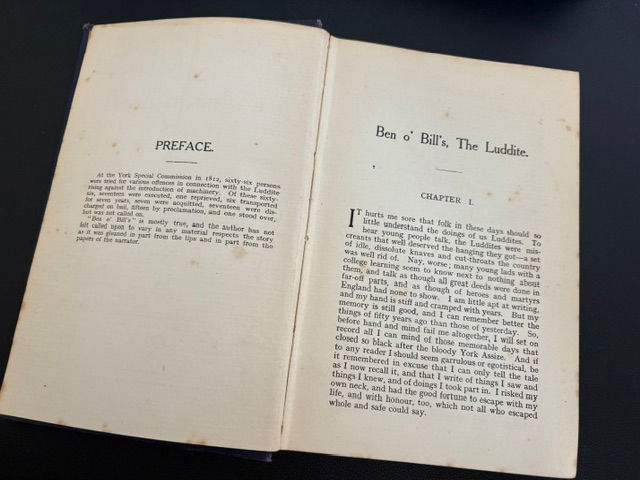
The Story
Ben o’ Bill’s, The Luddite follows the recollections of Ben Bamforth, an elderly Yorkshire textile worker looking back on the years before and during the Luddite disturbances of 1811–1812. Through Ben’s memories, D. F. E. Sykes recreates the world of the West Riding textile districts at the moment when domestic cloth producing communities were beginning to give way to mechanised industry and factory production. The naming Ben o’ Bill’s was common at the time, meaning Ben, Bill’s son (Ben of Bill), as William Bamforth was Ben’s father. This style of naming was often used to avoid confusion between one Ben Bamforth and another.
The story begins in the hillside communities around Slaithwaite and the Colne Valley, near Huddersfield, where weaving, farming and family life were closely intertwined. The early chapters portray the rhythms of pre-industrial Yorkshire life with chapel gatherings, fairs, market journeys, and the pride of skilled textile labour.
Conversations are recorded in the original dialect.
Unease develops as new machinery, larger mills and changing business practices begin to undermine the competitiveness of the independent croppers, weavers and small manufacturers. Conversations in workshops, inns and chapels increasingly turn towards the effect this is having on the prices (and hence income) the independent workers can achieve against the machine produced articles, and indeed in the case of cropping and finishing: the quality of the output.
At the same time, the Napoleonic Wars bring trade disruption, rising food prices and widespread hardship. Economic pressure deepens resentment toward manufacturers who adopt machinery seen as destroying skilled employment and undermining traditional working practices.
Against this backdrop, the Luddite movement slowly emerges in Ben’s locality of Huddersfield. Sykes presents it not as mindless hatred of machines, but as the reaction of communities who believe their livelihoods and social world are being swept away. Ben encounters the Luddites through his friend George Mellor and is persuaded to join the secret movement, swearing a solemn oath not to betray any member upon fear of death. He becomes active in the movement taking part in raids on mills and breaking machines.
Sykes follows the developments as the authorities respond to the Luddites’ challenges, culminating in the arrest and execution of George Mellor for the murder of William Horsfall.
Part historical novel, part oral memory and part social commentary, Ben o’ Bill’s ultimately becomes not only a story about Luddism, but about the profound human consequences of industrial change. You can get a digitised pdf of the book at huddersfield.exposed. It is highly recommended.
Prelude to Luddism
Modern discussions of the Industrial Revolution often begin with the factory. Sykes begins somewhere very different: the home. In the opening chapters, Ben Bamforth recalls the household economy of his family near Slaithwaite. The family were neither simple farmers nor factory workers. Like many households across the West Riding, they occupied a mixed world combining small scale agricultural activities with textile ones such as spinning and weaving.
Ben describes the weaving chamber in the upper part of the house:
“The warping and the weaving we did at home in the long upper chamber. We had four looms at home, and, moreover, we put our work out to the neighbours.”
That short passage captures an economic structure which now feels distant. Production was not concentrated in a single building owned by an employer. Instead, work was spread across households and communities. Families wove cloth in their own homes and often subcontracted work to neighbouring families. Skills, labour and production were distributed through local networks. The distinction between domestic life and industrial life was therefore far less rigid than it later became.
Ben remembers that however difficult times became, the family rarely lacked food because they still possessed a degree of self-sufficiency:
“We had the cows and the poultry and the pigs…”
This mattered enormously. The domestic textile economy was not wealthy, but it possessed resilience. Families retained multiple ways of surviving difficult periods. They were not yet entirely dependent upon weekly wages from a single employer.
The work itself required considerable skill. The handloom weaver, cropper or finisher was not a lower skilled operator in the later factory sense. Textile production depended upon:
judgement,
physical dexterity,
knowledge of fibres such as wool and later, cotton,
familiarity with dyes and finishing,
and years of practical experience.
This was one reason the arrival of mechanisation created such anxiety. Workers were not simply defending income. They were defending a social position rooted in skill and relative independence.
Textile workers had long adopted innovations that improved productivity and eased labour. What increasingly troubled many workers was not machinery itself, but machinery that reduced the value of their hard-won skills and transferred control over their working life to the mill owner.
The deeper problem emerged when machinery began to alter the structure of economic power itself. As larger mills developed, production increasingly moved “under one roof”, heralding the factory system. Machinery became more expensive, buildings larger and ownership more concentrated. Sykes captures the unease surrounding these developments in conversations between Ben’s father and other manufacturers:
“He’s bahn to ha’ all his wark done under his own roof, he says. He’s sick o’ croppers and their ways.”
That phrase — “under his own roof” — represented a profound transformation. The older system dispersed production among many households and workshops. The new system increasingly gathered workers into factories controlled by a smaller number of owners.
Under the domestic system, the pace of life, though often harsh, still retained elements of flexibility. Work followed the rhythms of agricultural life, daylight and local custom more than the rigid discipline of the factory clock. Sykes’s world remains full of fairs, wagon journeys, chapel meetings, inns, meeting with friends and neighbours to catch up on news and gossip.
Ben recalls travelling with his father carrying cloth to distant markets at Nottingham and elsewhere. These journeys remind us that the domestic textile economy was not isolated or primitive. Yorkshire cloth workers were already deeply connected to wider commercial markets long before the great mills transformed the valleys. Often their cloth would be exported to markets in Europe and America.
Yet by the opening years of the nineteenth century, this older world was coming under increasing pressure from many directions simultaneously. Britain was engaged in prolonged war with Napoleonic France. Trade routes were disrupted, export markets unstable and food prices rising sharply. Frank Peel, in The Risings of the Luddites, describes conditions of severe distress across the textile districts, with unemployment and hunger spreading rapidly. The conditions were set for the rise of Luddism.
Appendix
The Author D.F.E. Sykes

Thanks to Huddersfield Exposed for this information and picture.
Daniel Frederick Edward Sykes — usually referred to as D. F. E. Sykes — was a Yorkshire solicitor, journalist, novelist, historian and local antiquarian best remembered today for his monumental histories of Huddersfield and the surrounding valleys. He was born in 1856 and died in 1920.
Sykes occupies an unusual place in West Yorkshire history. He was not simply an academic historian writing from a university distance; he was deeply embedded in the social, industrial and political life of the district he described. His work combined archival research, oral tradition, industrial knowledge, folklore and radical social commentary. That mixture gives his books a distinctive tone — part historical survey, part civic memory, part moral argument about industrial society.
He is best known for two major works:
The History of Huddersfield and Its Vicinity (1898)
The History of Huddersfield and the Valleys of the Colne, the Holme and the Dearne (1906)
These books remain foundational texts for anyone studying:
Huddersfield’s textile industry
the growth of technical education
Nonconformity and civic culture
the Luddites
village and valley histories
industrialisation in the West Riding
What makes Sykes particularly valuable is that he wrote close enough to the nineteenth century to capture living memory of earlier industrial practices and communities. Many of the handloom traditions, dialect expressions, working customs and social relationships he recorded might otherwise have been lost.
He also wrote fiction and semi-historical novels rooted in Yorkshire life, including:
Ben o' Bill's, the Luddite
Tom Pinder, Foundling
Miriam: A Tale of Pole Moor and the Greenfield Hills
Sister Gertrude: A Tale of the West Riding (onlinebooks.library.upenn.edu)
These works often blended storytelling with social observation and local history. “Ben o’ Bill’s, the Luddite” in particular helped preserve popular memory of the Luddite disturbances around Huddersfield and the Colne Valley.
His life itself appears to have been turbulent. Sources indicate that he trained and worked as a solicitor, but later fell into financial and personal difficulties dealing with alcoholism and bankruptcy before a period of temperance (on which he lectured). One account notes that he spent time in the Crosland Moor Workhouse, a striking contrast for someone who had written extensively about the dignity and struggles of working Yorkshire communities.
Modern historians still study him not merely as a chronicler but as a participant in local political culture. The Huddersfield Local History Society has published work describing him as “The Local Historian as Activist,” recognising that his histories were not neutral compilations but interventions in debates about industry, class, identity and civic memory. (huddersfieldhistory.org.uk)
For the Huddersfield textile story, Sykes is especially important because he captured a transitional moment:
the fading memory of pre-industrial domestic weaving
the rise of mills and technical education
the growth of chemical dyeing and finishing
the civic institutions that emerged around industrial prosperity
the social tensions created by mechanisation
One of the most striking qualities of Sykes’ writing is that he understood textiles not simply as economics, but as a complete social system — shaping education, religion, politics, architecture, self-improvement and community identity across the valleys of West Yorkshire.


Comments