The Luddites in Huddersfield - 3
The Men Who Finished the Cloth:
Gig Mills, Shearing Frames and the Yorkshire Luddites
In a small stone workshop beside the River Colne at Longroyd Bridge, Huddersfield workers stretched cloth across wooden frames, raised the nap with teazles, wielded forty-pound shears and transformed rough broadcloth into one of Yorkshire's most valuable products. Within a few years, the world depicted in John Wood's finishing shop would become the focus of a notorious chapter in the history of the West Riding.

Luddism is closely associated with machine breaking and has become synonymous with being backward-looking and resistant to change. But, at the time, machine breaking was a response not just to new technology but to a fundamental and drastic change in the life of many textile workers. It was about the nature of work.
Not simply work as a means of earning a living, but work as skill, identity, status and independence. The conflict that erupted across the West Riding in 1811 and 1812 was not centred upon weaving or spinning. It focused on the final stages of producing Yorkshire broadcloth, where generations of specialised workers transformed rough woollen fabric into one of Britain's most valuable manufactured products.
To understand Yorkshire Luddism, it helps to understand the men who finished the cloth.
Finishing the Cloth
By the time a piece of Yorkshire cloth reached the finishing shop, it had already passed through many hands.
The wool had been scoured, sorted, carded, spun and woven. It had then been fulled, a process that cleaned, shrank and thickened the fabric to give it body, making a virtue of wool’s natural ability to felt. Yet the cloth still lacked the smooth, lustrous surface that made Yorkshire cloth famous.
That finish was created through a series of skilled operations collectively known as dressing or finishing.
The image below captures the essence of the scale and work in a finishing shop like John Wood's, in the years immediately before the Luddite disturbances. Workers carry out different tasks around the room. Cropping shears hang on the wall. Cloth is stretched across wooden frames. The atmosphere is one of routine industry and quiet familiarity. Yet the image records a world that was already beginning to disappear.

Raising the Nap
Before cloth could be cropped, and after fulling, its surface first had to be raised. This process was known as gigging. Gigging involved drawing loose fibres from the surface of the cloth to create a soft, even nap. The operation relied upon the dried heads of the teazle plant, whose stiff but flexible hooks were uniquely suited to the task. Unlike metal hooks, teazles could lift fibres without damaging the cloth.
The cloth was stretched over a sloping wooden frame known as a nelly. Workers then drew wooden handles fitted with rows of teazle heads repeatedly across the surface. The process required patience, judgement and experience. Different fabrics demanded different treatment, and an overworked piece could easily be spoiled.
The illustration captures this operation in progress. The image reveals an entire specialised world built around the raising and finishing of cloth. This was not unskilled labour. It was a craft.
The Cropper
Once the nap had been raised, the cloth passed to the cropper.
The cropper's task was to trim the raised fibres to an even length, producing the smooth finish expected of quality cloth. It was among the most demanding operations in the woollen trade.
The cloth was stretched tightly across a curved shearboard. Standing on a footboard above the wet floor, the cropper used enormous hand shears specially designed for the purpose. These shears measured more than three feet in length and weighed in excess of forty pounds. Additional lead weights were attached to increase their cutting power.
The work required considerable strength, but strength alone was not enough. Every cut had to be judged. Too deep and the cloth could be ruined. Too shallow and the surface would remain uneven. The cloth had to be moved repeatedly across the board and cropped again and again until the desired finish was achieved. It was painstaking, physically exhausting work that demanded years of experience.

George Walker's famous illustration The Cloth-Dresser, published in 1814, (above) depicts a master cropper at work while apprentices look on. It presents cropping not as labouring but as craftsmanship. The cropper stands at the centre of the scene, exercising judgement acquired through long experience.
For this reason, croppers occupied a respected position within the woollen industry. They were skilled craftsmen whose knowledge and abilities commanded relatively good wages. Many of the men who later joined the Luddite movement came from precisely this background.
The Machines Arrive
Manufacturers faced a different set of pressures. Demand for cloth was growing. Competition was increasing. Labour was expensive. Skilled finishing operations took time. The obvious solution was mechanisation.
The first challenge to traditional finishing came through the development of the gig mill.
Instead of raising the nap by hand using teazles mounted in wooden handles, the gig mill used large rotating cylinders covered with teazles. These machines could process cloth more quickly and more consistently than hand labour. Gigging itself was not new; what was new was the application of machinery to the process.

The machine threatened not simply jobs but a body of accumulated skill and knowledge that had previously given value to their labour. Croppers faced a similar challenge.
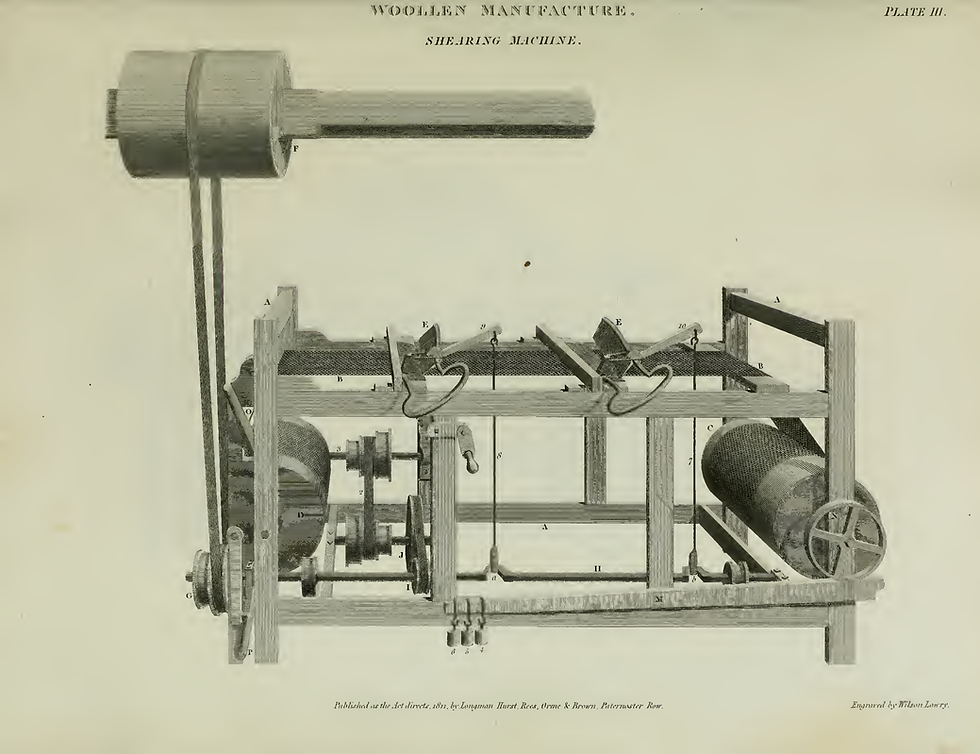
The shearing frame mechanised much of the cropping process. Work that had once required several experienced croppers could increasingly be undertaken by fewer workers operating machinery. Interestingly the Croppers' Shears are still retained in the Shearing Frame (labelled E). A new cutting part had not yet replaced them. The combination of gig mills and shearing frames threatened to transform the entire finishing process.
For manufacturers, the advantages were obvious. For workers, the implications were alarming.
George Mellor and John Wood's Shop
The connection between finishing trades and Yorkshire Luddism becomes particularly clear at Longroyd Bridge.
George Mellor, the most famous of the Yorkshire Luddites, worked as a cropper in the shop of his stepfather, John Wood. According to later accounts, the shop became associated with meetings and discussions that helped shape the local movement. Several attacks are believed to have been planned there, along with the campaign directed against manufacturers who embraced the new machinery.
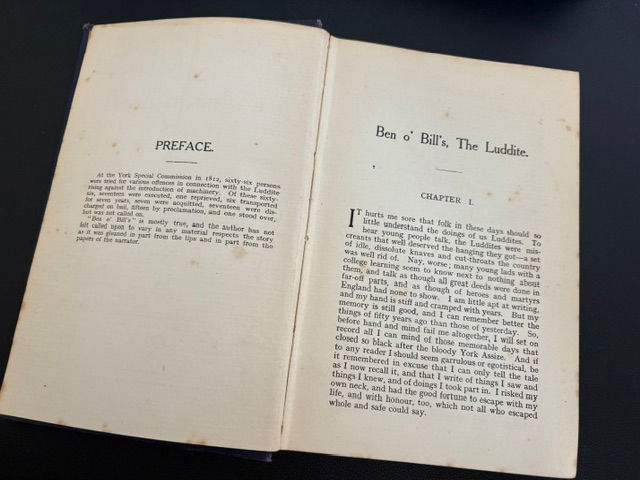
In Ben o’ Bill’s, Mellor is portrayed as a forceful personality who became a key leader of the movement in the area. William Horsfall was Mellor’s nemesis. A loud and forthright mill owner he came to represent what the Luddites were fighting against by equipping his mill with many of the machines they saw as taking their work. He is reputed to have said that “I will ride up to my saddle in Luddite blood”.
Mellor killed Horsfall and was later hanged for it. Horsfall had become a symbol of the industrial changes threatening the cropping trade, because the conflict escalated after the attack on Rawfolds, and because some Yorkshire Luddites had come to believe that violence against individuals was justified.
But many people who sympathised with machine breaking and with the workers’ grievances were appalled by the murder. The irony is that Horsfall’s death likely harmed the Luddite cause.
More Than Machines
The gig mill and the shearing frame genuinely increased productivity. Manufacturers were not mistaken about their economic advantages. Over time, mechanised finishing became part of a broader industrial transformation that increased output and reduced costs.
But technological change was also changing the balance of power within the industry and this was not lost on those whose craft it threatened. The finishing trades were built upon skill. The new machinery shifted value away from skill and towards capital investment. Men who had once possessed specialised knowledge increasingly found themselves competing with machines owned by others. This was the deep source of Luddite anger.
So, although in the first instance, the issue Luddites had with machines was that it took their livelihood, they realised it was also about who controlled the work, who benefited from innovation and what happened to those whose skills were rendered less valuable by technological change.
A Lost World
The workshop depicts an entire finishing economy: teazle preparation, gigging, cropping, brushing and pressing all taking place within a single community of workers. By the middle of the nineteenth century, much of that world had disappeared.
Gig mills and shearing machinery had become established. Small dressing shops declined. Production became increasingly concentrated within larger industrial enterprises. The methods shown in the Longroyd Bridge illustration belonged to an earlier age.
Sources and Further Reading
D. F. E. Sykes, Ben o' Bill's, The Luddite
Frank Peel, The Risings of the Luddites (1880; 1888 edition)
George Walker, The Costume of Yorkshire (1814), particularly The Cloth-Dresser and The Preemer Boy
Jeremy Clark, "John Wood's Cropping Shop at Longroyd Bridge, Near Huddersfield", The Yorkshire Journal (2019)
Adrian Randall, Before the Luddites
Malcolm I. Thomis, The Luddites: Machine-Breaking in Regency England
E. P. Thompson, The Making of the English Working Class


Comments