The Luddites in Huddersfield - 2
War, Wages and Factory Work - A Harder Life?

Britain Under Strain
When the Luddites emerged in Yorkshire, Lancashire and Nottinghamshire during the years 1811–1813, Britain was already exhausted by nearly two decades of war.
The wars with Revolutionary and Napoleonic France shaped almost every aspect of British life. They influenced trade, taxation, food prices, wages, political repression and industrial production. Although the conflict was fought largely overseas, its effects reached directly into the weaving villages and textile towns of northern England.
Britain's textile industry depended heavily upon export markets. Cloth produced in Yorkshire and Lancashire formed part of an international trading system stretching across Europe, the Atlantic and beyond. War repeatedly disrupted these connections. Napoleon's Continental System attempted to close European markets to British goods, while Britain's naval blockade system restricted maritime trade in return. Commercial uncertainty became constant.
Orders could disappear suddenly. Merchants delayed purchases. Manufacturers reduced production or cut wages. Workers who already lived close to subsistence found themselves increasingly vulnerable to fluctuations entirely beyond their control.
At the same time, wartime spending transformed the British economy. The government borrowed heavily to finance military operations while taxation rose sharply. Food prices increased during periods of poor harvest and disrupted trade. Bread — the foundation of working-class survival — became painfully expensive during the years immediately preceding the main Luddite outbreaks.
Traditional domestic weaving and finishing systems had already begun to weaken under pressure from mechanisation and factory production. In Yorkshire, skilled croppers feared that shearing frames would destroy their trade. Handloom weavers saw earnings decline as industrial production expanded unevenly across the textile districts.
For workers in districts such as Huddersfield, Halifax and the Colne Valley, the consequences were deeply personal. Combined with technological change and uncertainty of employment, these pressures produced not only poverty but also a profound sense of insecurity.
Contemporary reports repeatedly describe hunger, debt, pawned possessions, unemployment and growing desperation. The issue was no longer merely discomfort or declining status. In some districts, families genuinely struggled to feed themselves.
The government's reaction to unrest was shaped heavily by fear generated by the wider European situation. The French Revolution had deeply alarmed Britain's ruling classes. Political elites feared that labour protest, food riots and industrial unrest might evolve into wider revolutionary movements. Radical political organisations were watched closely, while public meetings and agitation were treated with increasing suspicion.
When machine breaking spread across the textile districts, authorities therefore interpreted it not simply as industrial vandalism, but potentially as part of a broader threat to national stability during wartime. The response was severe.
Troops flooded into industrial regions. Informers and spies were employed extensively. Machine breaking became a capital offence. Following the attack on Rawfolds Mill and the murder of William Horsfall, the state pursued leading Luddites with extraordinary determination. At times, parts of Yorkshire resembled an occupied territory more than peaceful industrial districts.
Bread, Wages and Survival
Before the worst effects of industrialisation and wartime disruption were fully felt, many skilled handloom weavers could earn a reasonably respectable living. They were rarely wealthy, but in periods of strong trade some enjoyed a degree of stability and independence that later generations would lose with the onset of industrialisation. What changed during the early nineteenth century was not merely wage levels, but purchasing power. The pressures created by war, inflation and disrupted trade translated directly into falling living standards.
One of the clearest ways to understand the pressures facing textile workers during the years surrounding the Luddite disturbances is to look not simply at wages, but at what those wages could actually buy.
Historians often measure this through the price of the quartern loaf — a standard loaf weighing roughly four pounds. Bread prices were recorded regularly and provide a remarkably clear indicator of living standards because they affected almost every household directly.
Period | Weaver Type | Weekly Wage | Bread Price | Approximate Loaves Purchasable |
c.1790 | Prosperous handloom weaver | 25s | 8d | ~37 |
c.1800 | Handloom weaver | 21s | 11d | ~23 |
c.1812 | Distressed handloom weaver | 10s | 1s 4d | ~7–8 |
c.1830 | Handloom weaver | 7s–10s | 8d–10d | ~10–15 |
c.1840 | Factory power loom weaver | 12s–14s | 7d–9d | ~18–24 |
The table shows not only the downward trend of wages, but also the surge in the prices of bread around 1812.
A skilled handloom weaver in the 1790s might support a family with a degree of dignity and independence. By the height of the Luddite crisis, many workers struggled simply to secure enough food.
The crisis was intensified because food consumed such a large proportion of household income. Modern families may spend a relatively modest share of earnings on food, but working households during the industrial transition often spent between fifty and eighty percent of income feeding themselves. Even small increases in bread prices could therefore push families into crisis. The psychological impact was also profound.
This helps explain the atmosphere described by Peel in “The Risings of the Luddites”. Workers carried "bloody loaves" mounted on poles in protest at soaring bread prices, while districts became crowded with unemployed and hungry labourers searching desperately for work. Hunger and insecurity formed part of the emotional landscape of the Luddite years.
The collapse in wages and purchasing power represented not only material hardship, but loss of status and dignity. Families who once maintained modest security increasingly faced debt, pawned possessions, fewer meals and dependence upon poor relief. Many handloom weavers did not regard themselves as unskilled labourers or paupers. They saw themselves as artisans — skilled producers with local standing and traditions of relative independence. This sense of decline appears repeatedly in both contemporary reports and later recollections.
Meat consumption, once possible for some artisan households, became increasingly rare during the worst years of distress. Diets narrowed toward bread, potatoes, oatmeal and tea. Small comforts disappeared gradually as insecurity deepened.
Fuel costs added further pressure, particularly in textile districts where warmth and dry conditions mattered both for health and for weaving itself. Cold and damp affected not only family life but the handling of yarn and cloth within domestic workshops.
For many households, the issue was no longer simply one of poverty. It was the growing fear that their way of life was disappearing: a life in which hard-won skills and craftsmanship earned not only a living, but respectability and status.
The New World of Factory Work
Falling wages and expensive food were only part of the story. The nature of work itself was changing.
Industrialisation represented far more than a new way of organising production. It altered the relationship between workers and work itself.
The rise of larger mills concentrated production "under one roof". Expensive machinery required capital investment on a scale impossible for most ordinary workers, and textile production increasingly moved away from dispersed household labour towards centralised systems controlled by manufacturers and overseers.
Within factories, the pace of work was no longer governed by household rhythms or seasonal flexibility. It was governed by machines.
Workers were expected to conform to strict routines, long hours and relentless timing. Industrial discipline became one of the defining features of the new system. Historians such as Sidney Pollard have shown how factories transformed attitudes towards punctuality, supervision, timekeeping and managerial control. This change could feel psychologically as well as physically oppressive.
One of the darkest aspects of early industrialisation was the extensive use of child labour. Children formed a crucial part of the workforce in many early textile mills because they were cheap, adaptable and easier to discipline.
Parliamentary investigations and factory reports from the early nineteenth century describe children working extraordinarily long hours under dangerous conditions. In some mills, shifts lasted twelve, fourteen or even sixteen hours a day. Children might crawl beneath moving machinery, piece together broken threads, clean operating equipment or carry heavy bobbins through crowded spinning rooms. Accidents were common and exhaustion widespread.
Particularly disturbing were the experiences of pauper apprentices. Many mills recruited children from workhouses, orphanages and parish poorhouses. These children frequently lived in employer-controlled dormitories. Contemporary investigations revealed cases of overwork, poor nutrition, disease, physical punishment and neglect. Not every mill operated under the worst conditions, but enough did for the issue to become a major national controversy.
Industrialisation also produced new forms of injury and disease. Textile mills exposed workers to cotton dust, deafening machinery, dangerous drive shafts, unguarded belts and exhausting heat. Workers could suffer damaged lungs, hearing loss, mangled limbs or scalping from exposed machinery.
Outside the mills, rapidly growing industrial towns introduced additional problems. Overcrowded housing, poor sanitation, contaminated water, smoke pollution and recurring epidemics became familiar features of many industrial districts. Observers visiting cities such as Manchester and Leeds were often shocked by the contrast between expanding industrial wealth and the visible poverty surrounding it.
Not all manufacturers behaved alike. Conditions varied considerably across industries and regions, while some employers believed healthier and better educated workers created more stable and productive enterprises.
For workers accustomed to greater control over their working lives, the factory system introduced new forms of dependence and discipline. Whether these changes represented progress depended greatly upon where one stood.
A Perfect Storm
One of the most important historical points is that early industrialisation often appeared harsher than the older domestic system not necessarily because pre-industrial life had been easy, but because traditional social protections weakened faster than new protections emerged.
Productivity increased rapidly, but the benefits initially flowed unevenly while cities, institutions and laws struggled to adapt.
It is clear that no single factor explains the hardship experienced in the textile districts of northern England. War, inflation, food shortages, industrial change and political exclusion reinforced one another. Workers did not experience these as separate economic, political and social problems. They experienced them as one worsening reality. Nor did hardship automatically produce organised resistance.
Britain had experienced poor harvests, trade depressions and periods of unemployment before. What made the years around 1811 different was a growing belief that the traditional safeguards upon which working communities had long depended were no longer functioning. Workers petitioned, appealed to magistrates and sought intervention from government, often invoking older ideas of fairness, customary rights and mutual obligation. Increasingly, those appeals appeared ineffective.
For some workers, the belief that the system itself was no longer capable of delivering justice proved almost as corrosive as the hardship itself, transforming economic distress into organised resistance. A letter sent in the name of "Ned Ludd Clerk" to a Yorkshire shearing-frame holder on 9 March 1812 captures this growing sense of frustration. Reproduced by Kevin Binfield in Writings of the Luddites (2004), the letter combines political grievance (Percival was Prime Minister at the time), a loss of faith in petitioning and constitutional reform, and opposition to machinery as part of a much broader programme of social and political change. Binfield notes that the identity of the intended recipient remains uncertain.¹
“The immediate Cause of us beginning when we did was that Rascally letter of the Prince Regents to Lords Grey & Grenville, which left us no hopes of any Change for the better, by his falling in with that Damn'd set of Rogues, Percival & Co to whom we attribute all the Miseries of our Country. But we hope for assistance from the French Emperor in shaking off the Yoke of the Rottenest, Wickedest and most Tyranious Government that ever existed; then down come the Hanover Tyrants, and all our Tyrants from the greatest to the smallest. And we will be governed by a just Republic, and may the Almighty hasten those happy Times is the Wish and Prayer of Millions in this Land, but we won't only pray but we will fight.”
The Redcoats shall know that when the proper time comes We will never lay down our Arms till The House of Commons passes an Act to put down all Machinery hurtful to Commonality, and repeal that to hang Frame Breakers. But We, We petition no more. That won't do—fighting must.”
To understand why so many workers lost faith in the traditional safeguards of society, it is necessary to consider the perspective of those who held power. Brian Merchant argues that mechanised factories represented far more than a new way of producing cloth. They offered the prospect of increased output, lower costs and greater national wealth. Britain's ambitions extended beyond the local economies of handloom weavers and croppers. Governments and manufacturers increasingly viewed industrial expansion as a source of economic strength, national wealth and geopolitical advantage.
At the same time substantial fortunes were made during the first decades of industrialization. Those who benefited most from the new system had far greater political influence and power than those whose livelihoods it disrupted.
Nor was factory work appealing or remunerative to the working community. The laissez-faire philosophy pervading government meant a strictly hands-off approach to working conditions and workers’ rights. There were some employers who did not take advantage of that but they are rare enough to be famous. People who became Luddites and those who were sympathetic to them suffered the hardship, saw the lack of support despite their attempts to obtain it honestly; the uneven distribution of wealth from the new ways and the unappealing nature of factory life.
The years surrounding the Luddite disturbances were therefore not simply a period of technological change. They were a period of profound social and economic upheaval that touched almost every aspect of working life in the textile districts of Yorkshire.
Understanding those pressures does not require us to approve of the methods adopted by the Luddites. It does, however, help explain why so many ordinary people believed that the world they had known was slipping away.
¹ Anonymous Luddite letter signed "Ned Ludd Clerk", March 1812, reproduced in Kevin Binfield (ed.), Writings of the Luddites (Baltimore: Johns Hopkins University Press, 2004), p.209.
Sources and Further Reading
Primary and Contemporary Sources
British Parliamentary Papers relating to wages, food prices, trade and labour unrest
Contemporary newspaper reporting from the Leeds Mercury, Leeds Intelligencer and regional Yorkshire press
Report from the Select Committee on Hand-Loom Weavers (1834–35)
Parliamentary Bread Assize records
Contemporary poor relief and wage records
Report from the Committee on the State of Children Employed in Manufactories (1816)
Report of the Select Committee on the Bill to Regulate the Labour of Children in the Mills and Factories (Sadler Committee Report, 1832)
Factory Commission Report (1833)
The Risings of the Luddites — Frank Peel
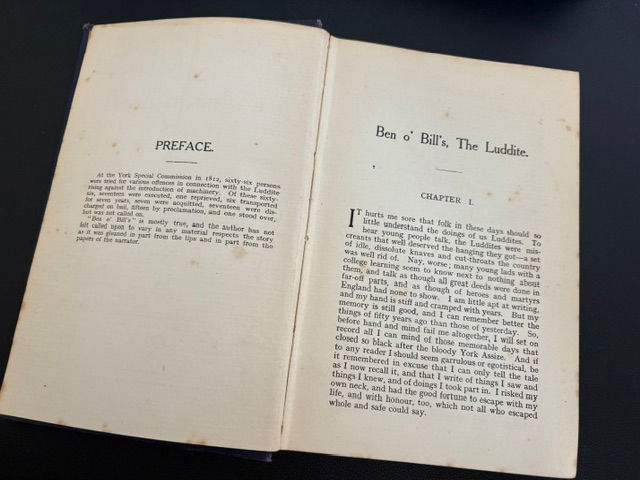
Ben o' Bill's, The Luddite — D. F. E. Sykes
Blood in the Machine, The Origins of the Rebellion Against Big Tech - Brian Merchant (pub. Little, Brown, 2023)
Major Historical Works
E. P. Thompson, The Making of the English Working Class
E. P. Thompson, Customs in Common
Adrian Randall, Before the Luddites
Emma Griffin, Liberty's Dawn
Duncan Bythell, The Handloom Weavers
Maxine Berg, The Age of Manufactures, 1700–1820
Robert Allen, The British Industrial Revolution in Global Perspective
Peter Lindert and Jeffrey Williamson, English Workers' Living Standards During the Industrial Revolution
David Gates, The Napoleonic Wars
Richard J. Evans, The Pursuit of Power
Donald R. Hickey, The War of 1812
Alan Taylor, The Civil War of 1812
Eric Hobsbawm, Industry and Empire
Asa Briggs, The Age of Improvement 1783–1867
Jane Humphries, Childhood and Child Labour in the British Industrial Revolution
Sidney Pollard, The Genesis of Modern Management
Pat Hudson, The Industrial Revolution
Malcolm I. Thomis, The Luddites: Machine-Breaking in Regency England
Robert Owen, A New View of Society


Comments